A Red Letter Day

The title of this blog entry is “A Red Letter Day.”  To my understanding there were red letters on the Roman calendar to denote festivals and special events.  Yesterday, in one viewing day I had 1017 page views.  This was unusual for me, and was the first time that I noticed this level of statistic.   

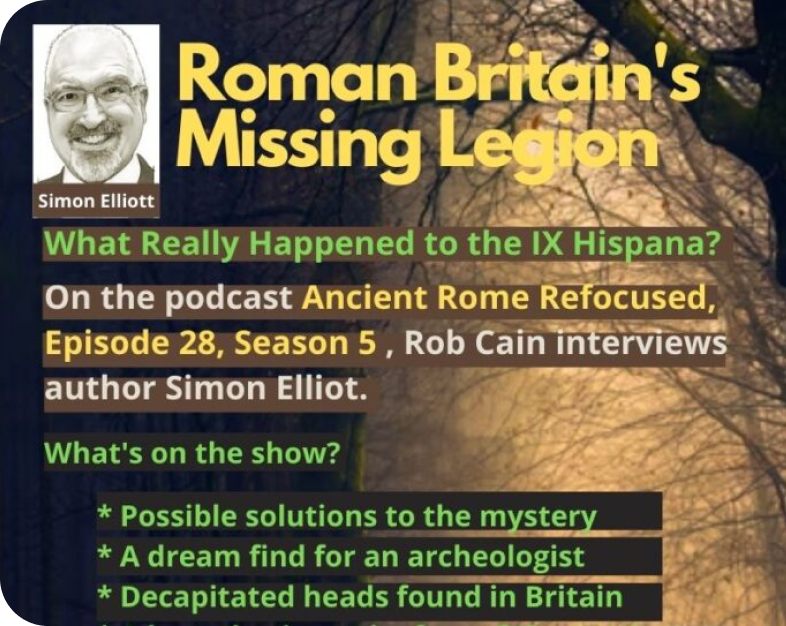
Today, I interviewed Dr. Carl RiCHARD (I put the last 5 letters in capitals to denote the accent on the last part of the name — he explained a CAJUN pronounciation).  He has written the book “Why We’re All Romans, The Roman Contribution to the Roman World.”     He inspired me, so I decided to change the direction of the next podcast for Season Seven.    Ancient Rome Refocused will concentrate on the influence of the Romans on early America and the U.S. today.  

Watch for it in the next couple of weeks.

I have been emailing back and forth on FaceBook one Mark Schauss.  He has a fascinating podcast called Russian Rulers History (on itunes by the way).  He has tantalized me with his observations on similarities between the Caesars and the Czars and has agreed to an interview.  I am going to call him tomorrow to interview him for a future show.

Stay tuned!

Comments

  • Barry · April 10, 2011 · 11:14 pm

    Wonderful! I often muse at how, in a very round about way, the United States is like the last Roman province. Of course, Cleopatra is of eternal interest and mystery. I’m especially interested in your your controversial angle (and unfortunately I have not read Stacy Shiff’s “Cleopatra: A Life”). I’m looking forward to that podcast also if you still do it.

    But getting back, look how much Latin still exists in law, botany, biology. A lot of our English language is based in Latin and Latin roots. Customs, superstitions, and rituals, such as marriage, have their roots or origin in Roman tradition. Names given to offspring are of Roman origin or original names such as Julia, Claudia, Cornelia, etc (Of course, we realize that the Romans were famous for ‘borrowing’ from other cultures, most notable, the Greeks).

    It is believed our founding fathers were influenced by the Roman Constitution, as well as by the Greeks and even the Iroquois Indians, though there is still debate and disagreement as to what and how much actually influenced the constitution.

    A fascinating paper on the Greek Polybius and perhaps his influence on the Romans and our founding fathers can be found at:

    Polybius and the Founding Fathers: the separation of powers
    http://mlloyd.org/mdl-indx/polybius/intro.htm

    And where is Rome today? A short article exploring and interesting theory.

    Does the Roman Empire Still Exist Today? It May – Even in Your Neighborhood
    http://ezinearticles.com/?Does-the-Roman-Empire-Still-Exist-Today?-It-May—Even-in-Your-Neighborhood&id=2568544

    Can’t wait to hear this podcast, take all the time you need (but hurry up).
    Hope things have been well for you and your family Rob.

    I love the way you bring Rome to life with your narration, music, sound effects, etc. I almost feel as though I’m there, hearing the sounds of Rome, horses and wagons, sculpturers, metal workers, clay potters, hawkers, the Cohortes urbanae coming down the road, the sounds of a Triumph or the games at the Colosseum, the screams of a criminal thrown off the Capitoline hill. The smells of wood burning, food cooking, bread baking, garbage rotting, body odor, body decay (if you’re near the Gemonian steps). The colors, murals, the feel of fabric, marble, etc. Internalizing how a Roman thought or felt.
    A much richer experience. Thank you!

Add a comment