I am enjoying the book THE ATTACK ON TROY by Rodney Castleden. One particular paragraph caught my eye. It was a story about a man who claimed to have lived another life during the time of Troy.
It’s on page 143.
“Pausania emphasized what a great honor it was to the Arcadians, land-locked and shipless, even many centuries after the event, to have taken part. it was a part of proto-history that gave the kingdom its national identity and was a great source of pride, as well as a rich brew of other emotions. There is a strange and telling story about Pythagoras staying in Argos in the sixth century BC, and being overwhelmed with emotion when he saw, nailed to the wall of the temple at the Argive Heraion, a shield that had been brought back to Greece as part of the spoils of Troy. The Argives who were with him at the time asked him why he was weeping, and he said that he himself had carried that shield in the land of Troy, as Euphorbus. The Argives thought he was mad, but he told them that if they took down the shield from the wall they would find an inscription inside it — ‘of Euphorbus’. They did, and Pthagoras was right.”
Mr. Castleden attributes it to a form of hysteria. The type of feeling where you want to be part of a certain event in the past. I believe Patton himself claimed to have lived past lives, and saw himself at the fall of Carthage. If we approach this skeptically, we could say that Pthyagoras was tipped on what was on the back of that shield by a goodly bribe to a local. We could also wonder if the story was true at all. In other worlds why let the truth stand in the way of a good story? I refer to the story of the 1945 Avenger Torpedo Bombers that were lost off the coast of Florida. Much has been made of them being lost to the interference of UFOs. Supposely there were radio transmissions, but a NOVA documentary interviewed the radio operators who were present that day, and UFOs and ”strange lights” never entered the conversation — the planes were found under the ocean even if they did turned up unexpectedly in the 70s movie E.T. Thank you ARGOSY Magazine — why let a good story stand in the way of the truth?
Do I think Pthagoras actually took that shield to Troy in another life?
Yes.
You weren’t expecting that answer were you?
Well, I do love a good story.
Rob Cain has traveled extensively through Europe, Italy, and Egypt. He was formerly on active duty with the United States Army. He is a fan of history, and enjoys reading books on the history of Rome. He currently has a podcast presentation on itunes and hipcast. The blog is for the free and open discussion of Ancient Rome based on Mr. Cain's observations noted in his podcast. Most episodes start out with an original dramatic narration written by Mr. Cain. In the podcasts he will include his own unique commentary, and interviews with subject matter experts. Comments are welcome and will be highlighted on the show.
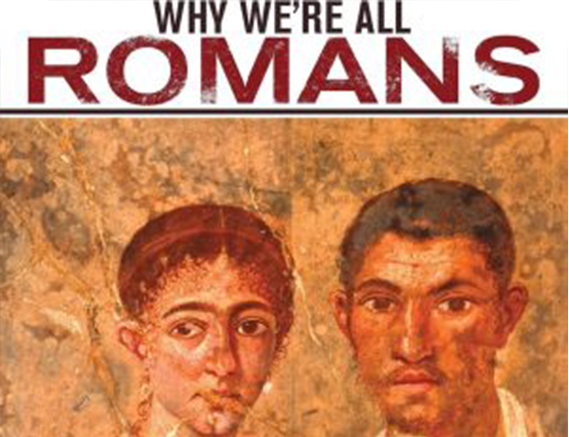
Episode 10, “Nothing New Under the Sun. Get Over it”, features the book, “The Ancient Guide to Modern Life” written by author, comedian, and TV commentator Natalie Haynes.” Whether political, cultural, or social, there are endless parallels between the ancient and modern worlds. Whether it's the murder of Caesar or the political assassination of Thatcher; the narrative arc of the hit HBO series, The Wire, or that of Oedipus; the popular enthusiasm for the Emperor Titus or President Obama – over and over again we can be seen to be living very much like people did 2,000 or more years ago. It's time for us to re-examine the past. Our lives are infinitely richer if we take the time to look at what the Greeks and Romans have given us in politics and law, religion and philosophy and education, and to learn how people really lived in Athens, Rome, Sparta and Alexandria.
This is a book with a serious point to make but the author isn't just a classicist but a comedian and broadcaster who has made television and radio documentaries about humor, education and Dorothy Parker. This is a book for us all, not for an elite.