Headline for Washington Post story (Tuesday, April 2, 2013).

Bones from time of Christ reveal brutal history

Germanic tribes showed no mercy in battles fought 2,000 years ago.

Really.  You figured that one out did you?

Despite my sarcasm I still enjoyed reading the article.  The author was Guy Gugliotta, Special (correspondent?).

The article opens with the massacre in the Teutoburg Forest.  He references Tacitus who records the finding of “bleaching bones, scattered or in little heaps…”  with “gibbets and torture pits” being mentioned.

USE IMAGINATION HERE.

Gugliotta backs up the brutality of the age with a recent dig by a Danish team that found in a bog just 325 miles south of the Roman massacre 40 men (Germanic?) ”hacked to bits” and thrown into the shallows of Lake Moso.   From what I am able to gather of the article that these ‘mass graves’ were sacrifices to the gods.   Gugliotta quotes Archaeologist Tina Thurston, University of Buffalo, “If you had something, the others wanted it.  The war booty was the thing, so they (Germanic tribes) attacked each other.”

I find the quote odd for the story.

What were the Germans doing that was so different than the Romans?  Germanic Tribes were in competition with each other…OK, got it.

The Romans were in competition with each other.  Pompey? Caesar?  Sulla?  Marius?   I guess my point is this.  No comparisons were made on the violence of both cultures.  The Germanic tribes threw the “losers” into a bog in the name of the gods.  The Romans threw captives and their “losers” into the arena [remember 'fighting to the death' had religious significance...at least early in gladiatorial combat].

It was a violent time and the article brings forth the question (at least for me):  do we call one civilization barbarian over the other because one happens to perform an odd thing called writing?

Maybe we do.

Ms. Cristina Corrirossi

Ancient Rome Refocused is looking for anyone that acted as a tour guide in Rome.    This is someone that has been in the business and would like to be interviewed on the podcast Ancient Rome Refocused.  Need someone who speaks English fairly well, and is up to promoting their business.  If you have a few adventure stories in your hip pocket, or some funny events that took place…so much the better.  I need someone who knows their ancient history and can relate factual events and how it relates to the forum, AND what life is like performing a job in Italia.   Nationality is not important.  If you know of anyone, please let me know. If you are personally interested please write me at the email provided.  Either leave a message on facebook or email me at rob@ancientromerefocused.org.
Forum tour guides are walking historians, and some are poets.

So what are some of the silliest tourists you ever met?  How do you rate the knowledge quotient of tourists and ancient history?  Are you a tour guide out of national pride, or is it simply a job for  you?
Please let me interview about your job.  Give us a number and we will call you on Skype.
Let us make you a star.  Questions will be provided early so that you can prepare.  Just need someone who can talk and can relate interesting and odd stories about the tour guide life.  I will even promote your business on the show.
There is a small audition (don’t worry…it’s painless) just call the following number:
Call the following number: 855-209-6230. 
Wait for the silly promo to end and give me a little insight into your life.

I just need to hear your voice.  If you get picked, I will interview YOU on Skype.

Random thoughts

Shakespeare is sprinkled throughout our language.  Dickens has been added to the stew as well: using the word ‘eyed’ to mean that someone looked someone over.   Well the myths are there as well.  For instance Robert Kennedy is quoted as saying, “Every man, woman and child lives under a nuclear sword of Damocles hanging by the slenderest of threads.”   Is that the real meaning?  Is that how the myth was intended to be understood?

The tale is really about living in someone else’s shoes.

The Tyrant Dionysius had a courtier named Damocles who envy the rulers life.  Heck, why not?  Great parties, women, song and you get to live in a palace.  So Damocles was allowed to live the life of his lord and while he sat on the throne he noticed a sword hanging my a thread over his head.   The moral being, “Each ruler lives with the possibility of unexpected death.”

Damocles quickly gave the throne back.

Considering what happened to Kennedy it seems an apt reference…and maybe since American Citizens are all rulers in their own right…maybe the sword hanging by a thread is still appropriate.

I could go on, but maybe I don’t want to open a Pandora’s Box.

What is lost intriques me…

“Oh muse, the following are the adventures of the great Hector of Troy.”

I am more intriqued by what is not found.  So much has been lost to dust, mites and the appetite of bugs.  Virgil survives and so does Homer, but what adventures have been lost to the ravages of time.  Could there have been a Hectoriad – an adventure of the great hero?  Something is waiting to be found…I feel it.  It sits somewhere out there in a box, in a scroll, in a leather bag encased in amber.

“Oh muse, the following are the adventures of the great Hector of Troy.  Before the fall of the great city, he was tasked by the gods to find the golden horse on the red sand plains…”
Well, I can dream.

Title — "Who is James A. Bretney?"

James A. Bretney, film director has put together a TV pilot about the Roman Governor Creticus ("The Man of Chalk.") How far is the Hollywood of the now, different from acting in the ancient world? This episode has interviews with actors: Michael Kripchak, Greyson Lewis and Michelle Stratton. There is an interview with Cody Garcia, film editor and philosopher. Mr. Cain interviews James A. Bretney (veteran) on his journey from war to the world of his imagination. Find out how to make a TV pilot. Universal Empire: The Story of Creticus can be found on FaceBook.

Included in this episode is Professor Art Lynch discussing the movie business, the art of the ancient stage, and the Screen Actors Guild (SAG). A comparison is made between Rocius the actor, Archibald A. Leech (Cary Grant), and James A. Bretney.

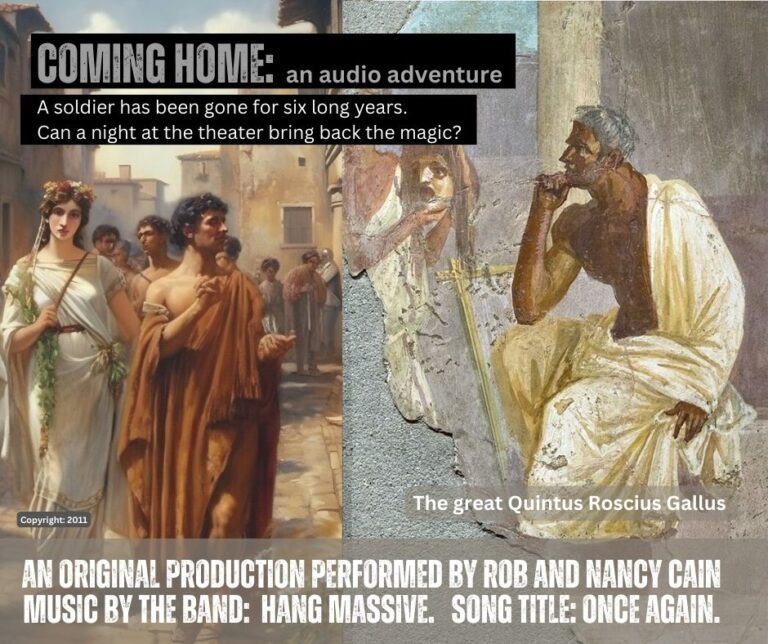
In this episode Rob and Nancy Cain perform a dramatic narrative of a Roman couple going to the theater to see the great Roman actor Quintus Roscius Gallus. The soldier has been away for six long years and doubts his wife's fidelity. She doubts his fidelity as well. Can a night at the theater change everything? Has the years changed him? Can she put aside her love for the great Quintus Roscius Gallus?

MP3 File

The Swerve

I once went to book sale.  It was at a local library.  I searched through the boxes and was immediately drawn to the old covers – you know the ones I mean, gold printing, leather bound, and that unmistakable smell of ‘age.’    It’s the best I can do to be that ‘explorer’ that I really wanted to be.  No ancient tombs for me, no digs, no adventures for me.   The name of the book is NEW CAESAR WITH VOCABULARY by Allen and Grenough.  It was a secondary education book, when Latin was a requirement (can you believe it?)  The editors of the book point out that special attention has been given to indirect discourse, the ‘bugbear’ (anyone know what a bugbear is?) of LATIN education.  The spine is shredded.  At one time it was the property of the Oakdale School Board.  Inside are the signatures of two owners.  One, ‘Capt. R.E. Lytle’ and the other is Harry F. Baumann, at 1013 Pear Avenue, in Pittsburg.

The copyright is 1886 and throughout the book are the best illustrated maps and drawings of the ancient world I have ever seen.

Gallia Antiqua is a map on the first couple of pages.  The map is a gorgeous piece of artwork, frame-able (I would like to frame it, but I can’t bring myself to destroy a book).   It’s the type of map that makes you feel a thousand years closer to that ancient world, even though the point of reference when it was drawn was only a hundred and fifty years  ago – more or less.   There are additional maps of the campaigns of Caesar with a red line showing his movements through Gaul and Britain.

What can I say, I’m a romantic.

And so – I believe – is Poggio Bracciolini.   In the year of 1487 there was an unemployed papal secretary that was hunting for books.  This is the true adventurer, and his story is told by Stephen Greenblatt in his book THE SWERVE.

You have to imagine a world where knowledge is held by monasteries or only by the very rich.  In this world the writings of Cicero, Plautus, and Epicurius are hidden in basements, in lock boxes and behind high walls.  Now, think about it, the knowledge of the ancients is slowly disappearing, mold and bugs are the enemies of paper, as well as the occasional fire.   The lack of instruction and education takes out from society the desire for reading.  Church doctrine and the suspicious of ‘pagan’ rites, including ignorance, make the keeping of pagan writings unimportant, and paper itself is valuable and tales of gods and observations by pagan philosophers are overwritten by the righteous and the holy.

And soon you have this man in 1487 riding through Germany in the time of kingdoms, where travel is dangerous (robbers, brigands, and wars running back and forth across the countryside) and people look upon strangers with suspicion.  Poggio was a man with a hidden mission, to discover ancient writings.  Forget the DaVinchi Code, this is made up adventuring, let’s look at the Poggio Code, a man who actually in a time of suspicion and contempt for knowledge searched out to discover the forgotten knowledge of a people who lived thousands of years before.    This is the stuff of legends.  Forget the fictional crap, Poggio is a 14 century Indiana Jones that actually lived.

The basis of Green blatt’s book is the finding of a manuscript by Lucretius called ON THE NATURE OF THINGS.  A poem – of all things – that oddly has the subject of science:

“Nothing ever springs miraculously from nothing…”

“Matter exists in the form of invisible particles…”

Atoms? Note* I believe the term he used were ‘seeds.’

“All atoms are in constant motion…”

“Time has no independent existence; rather from events themselves is derived a sense of what has occurred in time past, of what is happening at the present, and of what is to follow in the future.”

It is a book of ‘ancient physics’ and how the ancients saw the world.   And for something that was written by a people that only had a technology that employed geometry, mathematics and the blood of slaves, it is almost mind boggling that they were able to conceive the existence of the atom and such things as “…the universe is infinite, there can be no center…”

Imagine Poggio translating this.  Imagine how his pen must have hesitated in copying each line.  An adventure in the waiting…”What’s this?  What’s this?”

The Swerve is a national book award winner.  Greenblatt is an descriptive writer, that gives you the context to understand the importance of Poggio’s contribution.

Stephen Greenblatt gives us a unique perspective of the world of the 14th century and how the thoughts of the 1st and 2nd were saved from oblivion.

Sometimes, maybe most of the time, it’s not kings, celebrities or politicians that change ‘The Nature of Things’ (De Rerum Natura).  Sometimes, maybe most of the time, it is the quiet guy, with his stylus and his octopi ink writing out his manuscript from his thoughts and observations of the world about him – unimpeded by superstition or fear.  Maybe it’s even the guy pondering the face of the universe as his piece of chalk moves across the black graphite on a Sunday morning with the windows open to feel the spring breeze on his back.  Sometimes, maybe most of the time, it is the geeky looking guy in his parent’s garage outback tinkering with computer boards that unleashes an industry that changes how we work and see the world.  Sometimes, maybe most of the time, it’s simply the book hunter on a back of a donkey going from monastery to monastery in search of the past.

I hope so.

Scribe of the Xth

Chapter III

My name is Sanguine.

My squad name is Scribe.

For the rest of this account I shall call me what I was dubbed by my fellow soldiers.  Each soldier is given a name that best bears his personality.  I was the one who could write, the only one who could write…and thus my squad name was Scribe.  Sometimes they called me ‘Blood-scribe’ for sometimes my writings tell of misfortune.  However, for you who reads this account…Scribe is what I prefer to be known.  My mates call me Scribe.  I am Scribe to all.  I am Scribe to you.  There are many names we are called in life.  Now I am Scribe.

This is an account of our voyage.

The centurions packed us into the ships.  We were to set sail for Egypt

“They won’t be happy to see us,” I said.

“What country ever is?” the Sub-Centurion Valens said to the men.  “You march into their country, eat their food and fut their women.  We are not hospitable guests.”

http://thescribeofthexth.tumblr.com/

Scribe of the Xth

Chapter II

My name is Caesar.

I am of a noble house.

I am a direct descendent of Venus.

Pompey has fled to Alexandria.  May the gods shit on all relatives!

I come back to Rome and he defied me.   You would think that my brother- in- law, who married my sweetest daughter Julia, would be waiting for me with an army to support me rather than challenge my rights.  What’s more I would expect some support in the Senate.  May he be strapped to a rock and have his entrails eaten.  Julia the sweetest, Julia of the sunlit smile, was everything to me, and she dies in childbirth.  Her legs were stained with blood, and that old man can’t even keep his loyalty to me.

“Marius,” I told my clerk.  “Find Julia’s dowry and have it returned.”

I blamed the shits in the Senate.  They think me too powerful, and they build walls between two men that should have had an unbreakable bond.

The civil war is not my fault.  I crossed the Rubicon to establish my rights, and now I sit in an empty Rome.  The senators fled and took the gold.  They can’t even fight me in Italy.

http://thescribeofthexth.tumblr.com/

Scribe of the Xth

Chapter 1

My name is Sanquine.

I am a shield carrier for the 10th Legion.  I am the unofficial scribe.

Where did a bastard of the surbura learn his letters?    My mother paid for them by giving herself to the tutor Paladoris, allowing her to ‘pay’ for her lessons by a wood splinter in her ass as the Greek ploughed her up against any door available.  How do I know?  I peeked one day.

She told me to “never mind it.”    She said it was her way of “giving it to the Greeks” and she said she would give it again and again for my benefit and mine alone.

My mother was a practical person.

How did I get the name of ‘blood?’  Sanquine is an odd name, you say?

It is.

She said it was that color that marked me.  I was covered in it after birth.  She said it made me holy, and she was determined from the day I popped out that I should be able to write.  A priest of Isis said I was special.  Even a Jupiter priest called me special.  Both saw me use my fat thumb to scrawl something upon the bed linen.

Thoth.

I wrote the word with my fat thumb in the blood that was provided as ink.

http://thescribeofthexth.tumblr.com/


The Scribe of the Xth

Sometimes I can’t help myself.  I start to write.  Characters come out of the woodwork and inhabit my pen.

http://thescribeofthexth.tumblr.com/

What if a series of letters were discovered.  What if we got a peek into that whole ‘Cleopatra Affair’ without hearing it from an official historian.   What if in modern Alexandria a series of letters were found showing the true story of Cleopatra?

Of course…impossible…but that is the fun of imagination.

Follow

Get every new post on this blog delivered to your Inbox.

Join other followers: